
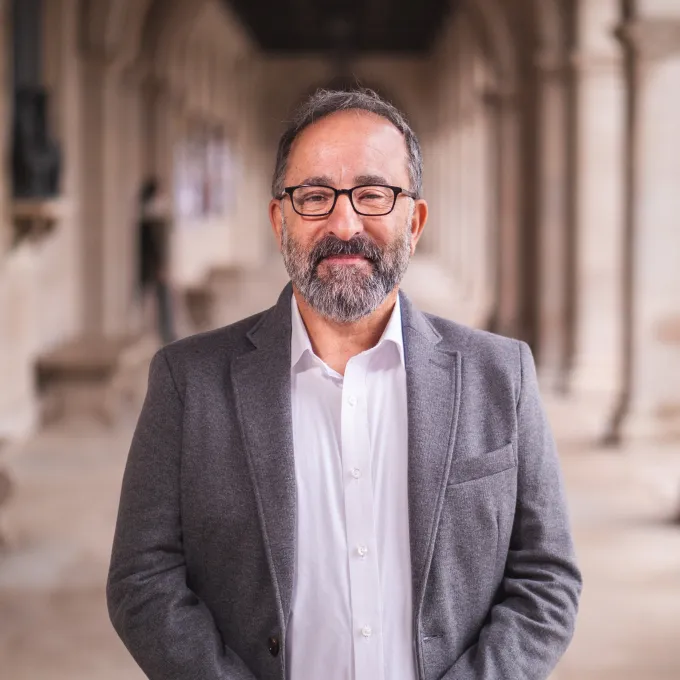
Hayrettin Yücesoy is a historian with a specialization in the premodern Middle East. His scholarly interests revolve around the intricate realm of political thought and practice, covering themes such as political messianism, monarchy, republican practices, visions of social order throughout premodern literature, and the historiography of these subjects.
I am a professor of Islamic History. Trained as a historian, I specialize in early Islam and the Abbasid Empire (750–1258 CE). My publications engage with debates on empire, political though, messianism, visions of social order, religiosity/secularity, inter-imperial connections, and the politics of cross-cultural encounters. The overarching concern of my research lies in the intersection of discourse and practice in sociopolitical contexts. My fluency in Arabic, Turkish, Ottoman, and Persian allows me to approach caliphal history from a broad world-historical perspective, enriching and nuancing our understanding of the Muslim past.
My most recent monograph, Disenchanting the Caliphate: The Secular Discipline of Power in Abbasid Political Thought (2023), marks a conceptual shift in my scholarship. While rooted in Abbasid intellectual and political history, it moves toward critical studies to examine the emergence of non-religious and non-ulema-centered notions of governance, opening new conversations in political thought and empire studies. Taking a critical stance against the overemphasis on Islam as the overdetermining framework of intellectual history, the book decenters both colonial-Eurocentric and Islamist narratives to offer a provocative reconsideration of key strands of Abbasid political discourse. It argues that political thought in the caliphal world diverged in the mid-eighth century into two competing visions: imamate (religious governance of the ulema) and siyasa (the “secular” politics of bureaucratic literati). This discursive split shaped not only the political practice of the “golden age of the caliphate” but also left a lasting imprint on political thought well into the early modern period.
My earlier book, Messianic Beliefs and Imperial Politics in Medieval Islam: The Abbasid Caliphate in the Early Ninth Century, based on my PhD dissertation at the University of Chicago under Fred Donner (with Cornell Fleischer and John Woods), examines the role of messianic and apocalyptic beliefs in the formation of the Abbasid Caliphate. It challenges conventional sociological interpretations that treat messianism as a marginal, oppositional ideology of the disenfranchised. Instead, I argue that the Ma’munic era (809–833) was defined by a symbiosis between messianic expectation and caliphal policy. Drawing on Muslim and non-Muslim apocalyptic sources, the book demonstrates how messianic beliefs informed Abbasid politics through fiscal reform, missionary activity, military expansion, and theological intervention.
My scholarly interest in early Islamic history began during graduate study in Jordan, where I completed an MA thesis under the supervision of the eminent historian ʿAbd al-ʿAzīz al-Dūrī (1919–2010). I later expanded this work into The Development of Sunnite Political Thought: The Formative Period (Taṭawwur al-Fikr al-Siyāsī ʿinda Ahl al-Sunna: Fatrat al-Takwīn), which traces the emergence of Sunni political thought between the eighth and tenth centuries. It explores how Sunni scholars negotiated their position between caliphal authority and sectarian rivals, balancing monarchical power with moral and religious imperatives. They upheld election, consent, and consultation as checks on caliphal overreach while defending cooperation with monarchy in the interest of communal unity and rule of law. This research laid the foundation for my later work.
I have also published numerous articles and book chapters in English, Arabic, and Turkish on inter-imperial connections, translation, empire, and resistance to empire. Currently, I am completing a monograph tentatively titled On Good Governance: Two Discourses of Politics in Early Islam. This study offers a critical Arabic edition and annotated English translation of two early Islamic political tracts, intellectual biographies of their authors, and an interpretive essay on political discourse.
In teaching, I focus on three interrelated areas: world and global history, intellectual and sociocultural history, and political thought and practice. My courses cover topics such as Islamic civilization, Islamic history, political theory, slavery, and the history of food. I welcome the opportunity to teach and advise graduate students in our program.